
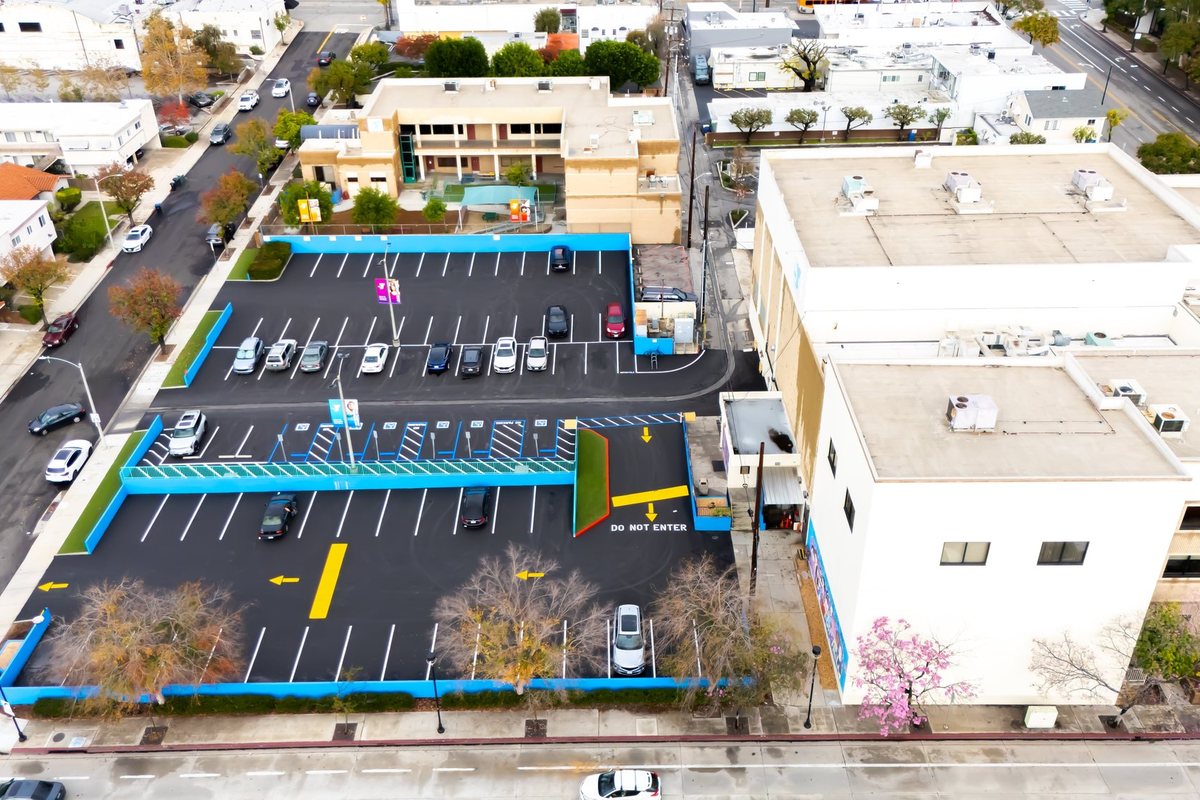
ADA non-compliance is one of the most common, and most expensive, exposures a California property owner faces. This checklist covers the essentials: how many accessible stalls you need, the slope and signage rules, and the errors that most often draw a demand letter.
The Americans with Disabilities Act (ADA), together with the California Building Code, sets enforceable standards for accessible parking. California is a particularly active enforcement environment because the Unruh Civil Rights Act allows statutory damages, which is why even small striping or signage errors can become costly claims. Use the checklist below as a starting point, then have a professional verify your site.
This article is general guidance, not legal advice. For certainty, have a Certified Access Specialist (CASp) inspect your property, requirements vary by occupancy, date of construction and local code.
1. Required number of accessible stalls
The number of accessible spaces is based on the total stalls in the lot. The federal ADA minimums are:
| Total spaces in lot | Minimum accessible spaces |
|---|---|
| 1 – 25 | 1 |
| 26 – 50 | 2 |
| 51 – 75 | 3 |
| 76 – 100 | 4 |
| 101 – 150 | 5 |
| 151 – 200 | 6 |
| 501 – 1,000 | 2% of total |
At least one in every six accessible spaces (and never fewer than one) must be van accessible, with a wider access aisle and higher vertical clearance on the route.
2. Stall and access aisle dimensions
- Standard accessible stall: at least 9 feet wide, with a 5-foot access aisle.
- Van accessible stall (California): a 9-foot stall with an 8-foot access aisle, or an 11-foot stall with a 5-foot aisle.
- Access aisles must be marked and may not be used for parking. Two stalls may share one aisle.
- The access aisle must connect to an accessible route to the building entrance.
3. Slope, the rule most lots fail
Accessible stalls and aisles must be nearly flat: no more than 2% slope (1:48) in any direction. This is the single most common violation, because lots settle and re-grade over time. A lot that passed at construction can drift out of tolerance years later. Slope should be verified with a digital level, not by eye.
4. Signage
- Each accessible stall needs a sign with the International Symbol of Accessibility, mounted so the bottom is at least 60 inches above grade.
- Van stalls require an additional "Van Accessible" plaque.
- California requires a posted minimum-fine sign ($250) at the lot entrance or each space.
- Signs must not be obscured by a parked vehicle.
5. Pavement markings
- The accessibility symbol painted on the stall surface (California requires it in a specific blue/white format).
- Access aisles striped with diagonal lines and often the words "NO PARKING."
- Markings must be maintained, faded paint is treated as non-compliant.
6. The accessible route
Compliance does not stop at the stall. There must be a continuous accessible path of travel from the parking space to the entrance, with curb ramps where needed, a running slope no steeper than 1:12 on ramps, level landings, and no abrupt changes in level greater than ½ inch.
When you repave or restripe a lot, you generally must bring accessible parking up to current code, not the code in place when the lot was built. Budget for ADA upgrades as part of any paving project.
The mistakes that draw lawsuits
In our experience the most common, and most preventable, issues are faded striping and symbols, missing van-accessible aisles, slopes that have drifted past 2%, signage mounted too low or blocked, and access aisles that have been quietly converted into parking. Most are inexpensive to correct, and far cheaper than a claim.
Frequently asked questions
How many ADA parking spaces are required?
It scales with lot size: 1 accessible space for lots of 1–25 spaces, 2 for 26–50, 3 for 51–75, 4 for 76–100, and so on. At least one in every six accessible spaces must be van accessible. Lots over 500 spaces use a percentage formula.
What is the maximum slope for an ADA parking space?
Accessible parking spaces and access aisles may not exceed 2% slope (1:48) in any direction. This is the most commonly failed requirement because pavement settles over time, so slope should be measured, not estimated.
Do I have to upgrade ADA parking when I repave?
Generally yes. Significant repaving or restriping typically requires bringing accessible parking, signage and the path of travel up to current ADA and California Building Code standards, not the standards from when the lot was built.
What size is a van-accessible parking space in California?
In California a van-accessible space is a 9-foot-wide stall with an 8-foot access aisle, or an 11-foot stall with a 5-foot aisle, with signage including a 'Van Accessible' plaque and adequate vertical clearance along the route.
Not sure your lot is compliant?
Caliber Paving handles ADA striping, signage and accessible-route work as part of every paving and restriping project across California, Arizona and Nevada.